

The digital companion for vacationers and expats :

Palermo
A first overview

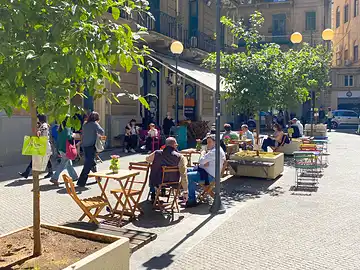
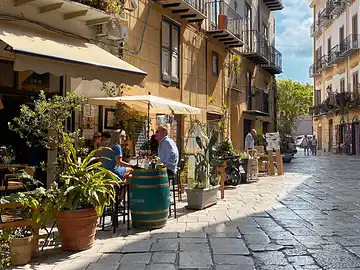
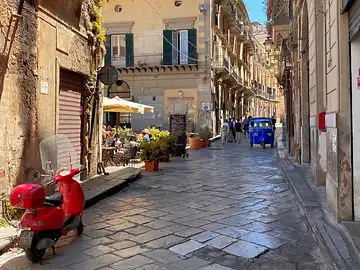
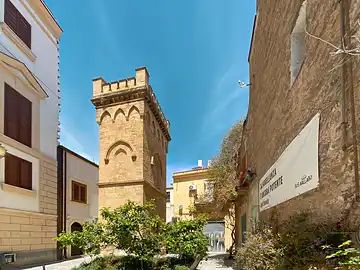
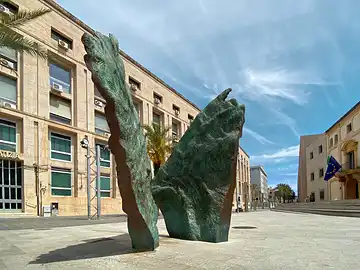
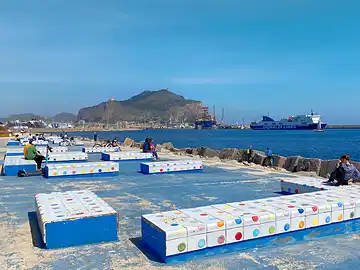
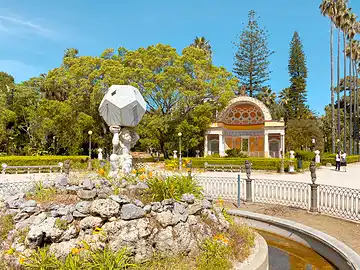
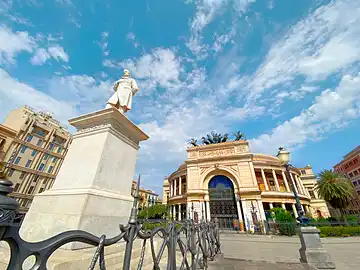
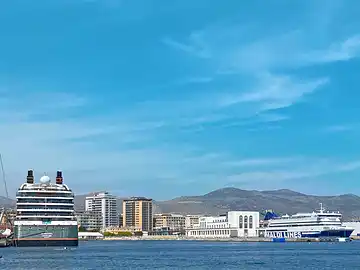
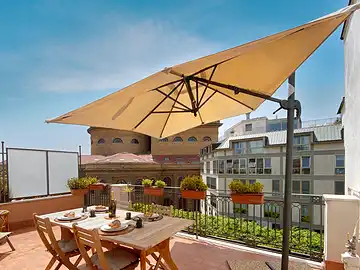
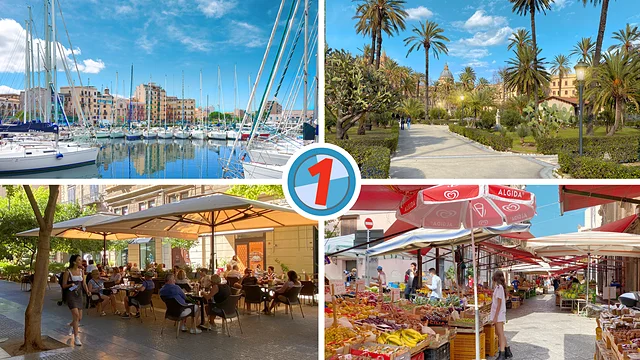
This photomontage shows the 'La Cala' marina, the 'Villa Bonanno' palm tree park, the 'Dolce Vita' atmosphere in a pedestrian zone, and the traditional 'Il Capo' market.
Sicily - Britta Bohn
Written by Britta Bohn
In Sicily since 1998

Palermo - Plenty to experience
Surprises, fun and dolce Vita

Here you'll find a first overview to help you explore Palermo on your own. Whether you arrive by plane, train, cruise ship, or even on your own boat.

We'll start with a walk (see map) through Palermo's pedestrian zones in the vast historic centre. Then we'll take our first glimpses into some of the side streets. This is where things are often much more interesting. Psst... don't tell anyone!

Are you captivated by Palermo's Dolce Vita? Then wouldn't it be pretty "cool" to have your own apartment here? With the right support, it's easier than you might think.

Sicily • All in one Place
The digital companion for vacationers and expats

How do I get there? How do I get around? How do I find a new home? Where can I find local support?

For these and other questions, "Sicily • All in one Place" offers practical tips, maps, online contacts, and local contacts.

Here, our authors share their knowledge with you. They have up to 30 years of experience in Sicily:

Sicily on Reddit

Here you'll find answers
From real people with real experiences

Do you have specific questions? Simply ask them on Reddit.

Reddit was originally a forum for tech en­thu­si­asts. However, word has spread that 'real people' share their knowledge here - mo­de­ra­ted by volunteers.

So it's no wonder that there's now a group for Sicily. Britta has also recently joined - under the pseudonym susolun:

Reddit Lockup Bubble

Arriving in Palermo
By Plane, Train, Cruise Ship or Yacht

Is this your first time in Palermo? Would you like to explore the city on your own? Then here's a first overview of what is arguably Italy's most exci­ting city. We'll use the city's four main pedestrian zones as our guide.

Whether you arrive at the main railway station, the marina, or the cruise ter­mi­nal, one of the pedestrian zones is al­ways just a short distance away - the perfect place to take your first steps in Palermo.
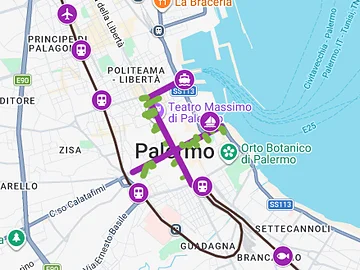
Screenshot of the 'Palermo - Overview' map on Google Maps

Map

Even in the small preview of the map, you can immediately spot Palermo's central pedestrian zones. They are marked with purple lines and run through the entire historic city centre.

The short green lines indicate side streets where there is plenty to discover.

The map also shows all holiday lettings offered by Solemar Sicilia. To keep things simple and easy to navigate, you can easily show or hide their locations on the map.
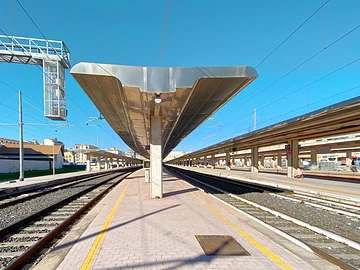
A platform at Palermo Central Station.

Train

Palermo has excellent rail connections and several railway stations - including one right at the airport.

So, if you want to explore Palermo on your own but would rather stay out­side the city, look for ac­com­mo­dation near a railway station. There's hardly an easier way to get around.

If you prefer to stay right in Palermo, you can do the opposite and take the train on exciting trips into the sur­roun­ding area - for example, to the fishing village of Santa Flavia.
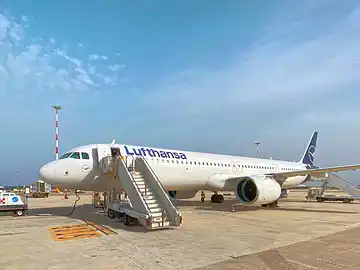
An aeroplane parked at Palermo Airport.

Airport

Palermo Airport has been significantly expanded and upgraded over the past 20 years. One of the most important ad­di­tions is its connection to the railway network in northwestern Sicily.

This railway line runs along the coast and offers holidaymakers and expats a re­laxed way to experience Sicily without a car.
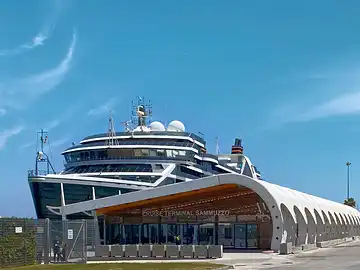
A cruise ship is moored at the 'Sammuzzo' cruise terminal in the port of Palermo.

Cruise terminal

For several years now, Palermo has also been a popular destination for cruise ships. The city is responding to growing demand and is fundamentally modernizing its port.

The port can now accommodate several cruise ships at the same time. The photo shows the "Sammuzzo" cruise terminal, which opened in early May 2026.

As you can see on our overview map, the pedestrian zone of Via Emerico Amari begins directly opposite the port.

The route between the two leads across the wide and busy Via Fran­ces­co Crispi. In the future, a pedestrian bridge is planned to cross the road. This will provide the perfect con­nec­tion between the historic city centre and the cruise terminals. Until then, pedestrian traffic lights will help you cross safely.
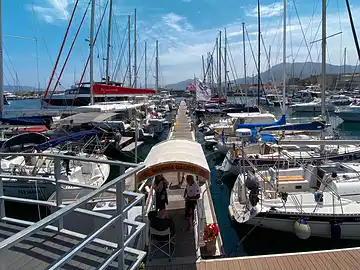
A jetty for visiting boats at the 'La Cala' marina in Palermo.

Marina

The coolest way to arrive in Palermo is probably by your own boat. For this, the "La Cala" marina is the perfect des­ti­na­tion. On this map (navily.com), you can see the exact locations of all berths for visiting yachts. The photo shows an example.

"La Cala" is perfect because, as you can see on our overview map, a pe­des­trian zone begins right here too - Via Vittorio Emanuele.

Living on your own boat with one of Italy's most exciting cities just around the corner - if that isn't cool...

Add 'Sicily • All in one Place' as a preferred source on Google

Get better search reults

Since May 2026, there has been a new feature for anyone who uses Google a lot and has a Google account. You can now tell your account which websites you prefer.

This allows you to tailor Google Search to your needs.

To add "Sicily • All in one Place" log in to your Google account and then click here:

Pedestrian zones
In the Old Town of Palermo

Palermo has become so attractive to visitors and residents in no small part because of its two main pedestrian zones, Via Maqueda and Via Vittorio Emanuele. Added to this is the fact that the main railway station and the marina are located at two ends of these pedestrian zones.

To provide a connection to the cruise terminals as well, Via Emerico Amari and Via Ruggero Settimo are also being converted into pedestrian zones.

The pedestrian zones form a cross right in the heart of Palermo's vast historic city centre, making them perfect reference points for us - and for all other visitors.

As well as helping you find your way around, they also offer plenty of options to satisfy hunger and thirst. That's all very convenient, but un­for­tu­nately, you won't see much of the actual historic city centre along these main routes.

Fortunately, the solution is very simple: quite literally, you just need to look "around the corner" - into the side streets. The most interesting ones are marked in green on our overview map.

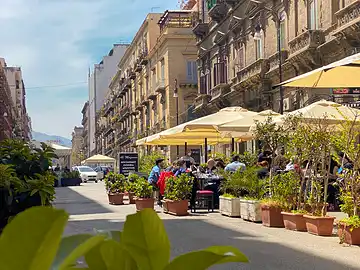
People are sitting relaxed at tables outside restaurants on the pedestrianised street 'Via Emerico Amari' in Palermo.

Via Emerico Amari

Palermo is investing heavily in mo­der­ni­zing its port - moving away from "dirty" industry towards "clean" cruise tourism.

Via Emerico Amari connects the en­trance to the port with the historic city centre. It therefore makes sense to transform it into a pedestrian zone and connect it to the port by a pedestrian bridge.

At the moment (May 2026), Via Emerico Amari is already largely free of traffic. In the long term, it is in­ten­ded to develop into something similar to what Las Ramblas is for Barcelona.

'Dolce Vita' in Piazzetta Francesco Bagnasco, Palermo.

Via Ruggero Settimo

Via Ruggero Settimo has also only recently become a pedestrian zone. However, there are several very interesting side streets here. They are marked in green on our overview map:

  • Piazza Castelnuovo: A beautiful square (Wikipedia) with palm trees and sculptures.
  • Via Principie di Belmonte: A traditional café with a large outdoor seating area.
  • Via di Stefano: Leads to the Dolce Vita atmosphere of Piazzetta Francesco Bagnasco (photo).
  • Piazzale Ungheria: An example of post-war architecture, featuring Palermo's tallest skyscraper, the Grattacielo Ina Assitalia (Wi­ki­pe­dia, it). Its architectural style is a con­ti­nu­ation of the Rationalist (Wi­ki­pe­dia) movement that emerged in the 1920s and 1930s.
  • Via Generale Vincenzo Magliocco: Here, too, 1950s architecture dominates - but this time combined with a touch of Dolce Vita. The street's namesake, Vincenzo Magliocco (Wikipedia), earned an infamous reputation for using mustard gas against the civilian population during the Second Italo-Ethiopian War (Wikipedia).
A bar in the charming alleyway 'Via del Ponticello' in Palermo's old town.

Via Maqueda

Via Maqueda (Wikipedia) was once the grand boulevard of the Spanish oc­cu­piers of Sicily. Today, it is an important pe­des­trian zone that attracts visitors from all over the world.

For explorers, it offers several very interesting side streets. They are marked in green on our overview map:

  • Piazza Giuseppe Verdi: The world-famous Teatro Massimo (Wi­ki­pe­dia) naturally dominates the square. On the southern side, at the corner of Via Rossini, you'll find a charming old cinema (Rouge et Noir) with an interesting façade.
  • Via Alessandro Scarlatti: Unassuming at first glance, but interesting for anyone interested in architecture, culture and history. Here you'll find a former open-air variety (Balarm, it) theatre, a building that once housed 'war-disabled veterans' (Pa­ler­mo­vi­va, it), and a fire brigade (Le Vie dei Tesori, it) barracks.
  • Via dei Candelai: Candles (Italian: "candele") were once made here. Today, the street is home to various cultural initiatives.
  • Via del Ponticello (photo): In the Middle Ages, there was a bridge (Italian: "ponte") here crossing a small river (Pa­ler­mo­viva, it). Today, the area is dominated by "La Dolce Vita".
  • Via delle Case Nuove: A well-known route to the Ballarò (Wikipedia, it) market.
A Vespa, an Ape and the outdoor seating area of a restaurant on 'Via Alessandro Paternostro' in Palermo.

Via Vittorio Emanuele

Via Vittorio Emanuele is better known in Palermo as Càssaro (Wikipedia) and has traditionally been the city's con­nec­tion to the sea. Today, it is an important pe­des­trian zone that attracts visitors from all over the world.

For explorers, it offers several very interesting side streets. They are marked in green on our overview map:

  • Mura delle Cattive: A promenade with views of the sea. In Italian, cattive actually means "bad", but in this context it refers to "wi­dows". This article (Balarm, it) describes the history of the "Wall of the Widows".
  • Piazzetta delle Dogane: A customs station once stood here; today, it provides access to the marina.
  • Piazza Marina: Home to a park with huge trees (Wi­ki­pe­dia) and a flea market on Sundays.
  • Vicolo dei Calzonai: Trousers were once made and sold in this street. Palermo's historic centre has many streets named after traditional crafts (Palermoviva, it), and their Sicilian names can be confusing. For example, calzonai might suggest tailors, but actually refers more closely to shoemakers.
  • Via Alessandro Paternostro: Via Alessandro Paternostro: This street (photo) became known through­out Italy because it is home to the restaurant that was the first in Palermo to report its extortionists (Cor­ri­ere della Sera, it) to the authorities.
  • Piazzetta Visita Poveri: This alley is known for the "speech bubbles" hanging between the buildings. Its name goes back to an old bro­ther­hood (Balarm, it) that once had a church on this street.
  • Salita San Antonio: Here we have a good example of restaurants located away from the hustle and bustle.
  • Vicolo Brugnò: This street still gives you a glimpse of historic Palermo. Laundry is still washed in the street here.
  • Via Pietro Novelli: This street is known for traditional Sicilian puppet theatre (Wikipedia).
  • Villa Bonanno: One of Palermo's most beautiful parks, famous for its palm trees (Wikipedia, it).

Neighborhoods
In the centre of Palermo

In this section, we describe the neigh­bor­hoods in central Palermo. Our overview map shows the boundaries of these neigh­bor­hoods with a somewhat loose interpretation. You can find the exact boundaries and names of all neigh­bor­hoods on Wi­ki­pe­dia here.

Our descriptions focus on lesser-known stories and details of each neigh­bor­hood. For the "usual" sights, we provide links to informative resources on the internet - especially Wikipedia.

The 'Torre d'acqua delle Sette Fate' water tower in Piazza Santa Chiara, Palermo.

Albergheria

Palermo has only existed for around 3000 years. Before that, the area was fertile land fed by rivers that carried water from the nearby mountains towards the sea. The Albergheria neigh­bor­hood de­ve­loped along the Kemonia River (Wi­ki­pe­dia, it), which connected the neigh­bor­hood with the sea. Where the famous Chiesa del Gesù (Wikipedia) stands today, there was once a harbor.

Rivers occasionally overflow their banks. In a natural en­vi­ron­ment, this is not ne­ces­sarily a problem, but for the residents of Albergheria, it was. Over time, water management therefore became essential. The river was diverted and built over, while drinking water was brought down from the mountains through canals. Water pressure was regulated by pipes inside towers - the so-called surge tanks (Wikipedia).

Today, a few ruins of these water towers can still be found in Al­ber­ghe­ria. The Torre d'acqua delle Sette Fate (Google Maps) was recently renovated and is becoming a popular landmark of Albergheria (photo).

Monument to the victims of the Mafia in Piazza della Memoria, Palermo.

Capo

The official name of the Capo neigh­bor­hood is "Seralcadio". The name dates back to the Arab period in Sicily and means "street of the judge". And indeed, justice is something of a recurring theme in the neighborhood. Even behind the scenes. People here still tell stories in the streets about a secret society called the Beati Paoli (Wikipedia). According to legend, they helped the poor and oppressed, making them something of Palermo's Robin Hood.

Others (Balarm, it), however, see the Beati Paoli as a criminal gang - or even as the origin of the Mafia. Taking a sober view, the evidence is scant. There is not even solid proof that the Beati Paoli actually existed.

The existence of the Mafia, by contrast, is brutally obvious. And the successful fight against it by the justice system began in the Capo neigh­bor­hood. The two world-famous judges Paolo Bor­sel­lino (Wi­ki­pe­dia) and Giovanni Falcone (Wi­ki­pe­dia) worked at the local Palace of Justice (Google Maps).

Our photo shows the square (Google Maps) between the buildings. It is dedicated to the victims of the Mafia.

View of a ferry and the harbour of Palermo from the Foro Italico.

Foro Italico

For ancient peoples, the bay that is now home to the marina was a perfect natural harbour. The ancient Greeks called this place Pa­nor­mos. Pan means "all" and ormos means "bay" or "an­cho­rage". Palermo and the sea are therefore, in fact, intimately connected.

This was still true of Palermo until the beginning of the 20th century, as the pictures on this website (Cara Palermo, it) show. The Foro Italico - the link between the city and the sea - was evidently one of the city's most important public spaces at the time.

Then came the Second World War. Palermo's historic centre was bombed, and the Foro Italico was severely damaged. But instead of repairing it, the rubble from the bombed-out buildings was dumped here. Eve­ry­thing was levelled, and a multi-lane road was built. Palermo was now cut off from the sea, and the Foro Italico gradually fell into decline.

Then, with the successful fight against the Mafia, Palermo began its rebirth at the end of the 20th century. One of the goals was - and still is - to re­con­nect the city with the sea. The wide road is still there, but the even wider strip between the road and the sea is now a re­cre­ational area that continues to be developed.

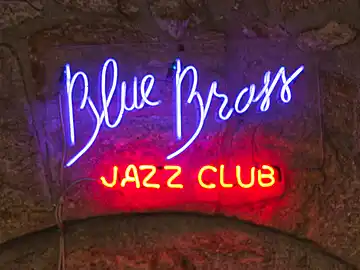
Neon sign for the 'Blue Brass' jazz club in Palermo.

Kalsa

As described in our overview of Sicily, jazz has deep roots on our sunny island. And its heart beats right in the middle of Palermo, in the Kalsa (Wikipedia) neighborhood.

The reason is the jazz school (brass­group.it) and the Blue Brass jazz club (photo) in Via dello Spasimo, as well as the jazz concerts held at Teatro Santa Cecilia (Wikipedia) since 2015.

This theatre was built at the end of the 17th century - right in the middle of what was, at the time(!), Palermo's most prestigious neighborhood, Kalsa. Over time, however, Palermo con­ti­nued to grow, and world-famous theatres such as Teatro Massimo (Wikipedia) and Teatro Politeama (Wikipedia) were built.

Palermo's "upper-class" residents moved to the neighborhood of the same name, Politeama, while Kalsa increasingly became known as a Mafia stronghold. In the 1950s, Teatro Santa Cecilia was reduced to use as a warehouse - until the energetic Brass Group took over the theatre in 2010.

Teatro Massimo is widely regarded as a symbol of Palermo's rebirth after the dark era of Mafia rule. However, the positive influence of the jazz scene on this development should not be under­esti­mated. After all, the Brass Group was founded as early as the 1970s - with international support from jazz greats such as Miles Davis (Wikipedia).

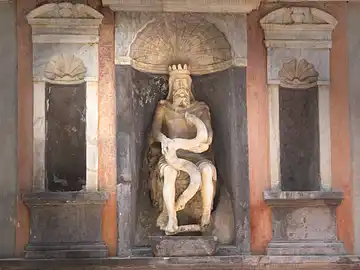
The Genius Loci 'Genio del Garraffo o Palermo lu Grandi' in the La Loggia district of Palermo.

Loggia

Palermo's Loggia (Wikipedia) neigh­bor­hood is first and foremost associated with its historic market, the Vucciria (Wikipedia).

But if you simply turn a corner, you can discover Palermo's ancient roots. Here, the Genius del Garaffo (Google Maps) watches over the neighborhood (photo).

The idea of the Genius comes from Roman mythology and refers to a pro­tec­tive spirit. In our case, it is a Genius Loci (Wikipedia) - the protective spirit of a particular place.

There are various representations of the Genius in Palermo. At the centre of almost all of them is an old man wea­ring a crown, accompanied by a snake that usually bites the man in the chest and, occasionally, a dog.

Christianization brought with it other patron saints. Since the Middle Ages, Saint Rosalia (Wiki­pedia) has watched over Palermo. But Palermo has always been religiously tolerant. Rosalia there­fore never displaced the Genius. So, even today, two protective figures watch over Palermo. Better safe than sorry.

The sundial in Palermo's 'Villa Giulia' park.

Oreto-Stazione

At first glance, the Oreto-Stazione (Wikipedia, it) neighborhood may not seem particularly attractive. Its centre­piece is the main railway station, with its sprawling network of railway tracks.

As is so often the case, however, it is worth taking a second look - for example, from above using Google Maps. Two large green spaces near the sea then come into view: Villa Giulia and the Botanical Garden (Wikipedia).

When Goethe visited Palermo during his Italian Journey (Wikipedia) in 1787, the Villa Giulia park had just been com­ple­ted. Goethe praised it almost ex­ube­rantly. It is easy to understand why, especially today, when you leave the hustle and bustle of the city behind and immerse yourself in Mediterranean greenery (photo).

This is even more true of the Botanical Garden. Originally established for use by the university, it is also open to in­te­res­ted visitors for a small admission fee.

Looking at the map again, another unusual feature catches the eye in the southwest of the neighborhood. It is the Cimitero di Sant'Orsola (Wikipedia, it). It is associated with two historical dis­tinc­tions. First, it was the first European cemetery open to people from all social classes. Second, it is home to the Chiesa del Santo Spirito.

The church is considered the starting point of the Sicilian Vespers (Wi­ki­pe­dia), an uprising against French rule in Sicily during the Middle Ages. It had a major impact throughout the Me­di­ter­ranean region, but ultimately brought Sicily little more than a new occupying power - the Spanish.

The monument to Ruggero Settimo in the foreground, with Palermo's Teatro Politeama in the background.

Politeama

Until well into the 18th century, Palermo consisted of four neigh­bor­hoods: Albergheria, Capo, Kalsa and Loggia - essentially what we now call the "historic city centre".

By the second half of the 18th century, the city had simply become too cramped, and Palermo expanded with an extension of Via Maqueda. This marked the beginning of Via Ruggero Settimo.

During the 19th century, a new neigh­bor­hood for wealthy Palermitans developed around the street. This was where the city's artists and intellectuals gathered, and where the spirit of the revolutions of 1848 (Wikipedia) was also in the air.

In fact, these revolutions began in Palermo and then spread across Europe. In Sicily, the aim was to break free from Spanish rule and establish the Italian nation-state.

Palermo continued to grow. As a result, an extension of Via Ruggero Settimo was launched and, in keeping with the spirit of the times, named Viale della Libertà (Wikipedia, it). Teatro Politeama (Wikipedia) was built at its beginning (photo), giving the neighborhood its name.

A barge with a cruise ship in the port of Palermo.

Porto

As we have already seen above, the restoration of the Foro Italico is, in a sense, intended to give the people of Palermo their sea back.

The modernization of the port is aimed in exactly the opposite di­rec­tion. The goal is to make Palermo more attractive to visitors from all over the world and to move away from "dirty" industry towards "clean" cruise tourism.

The port's location is perfect for this - it is just a stone's throw from the centre of Palermo. At the moment, however, the busy multi-lane Via Fran­ces­co Crispi still acts as a barrier between the city centre and the cruise terminals. Pedestrian bridges are planned to change this in the future.

Maurizio Carta, Professor of Urban Development at the Uni­ver­sity of Palermo, has outlined the goal in his article Palermo rinasce dall'acqua (Portus online, it) in terms that are easy to understand. The photos of the new structures already in exis­tence, together with the plans for future expansions, make the vision clear: Connettere terra e mare - Portare la città verso il porto.

Staying in Palermo
In the heart of the city or just beyond its gates

Those who have arrived by cruise ship or on their own yacht already have some­where to sleep. Everyone else will need accommodation in Palermo - such as a holiday lettings.

But does it have to be in Palermo? Not necessarily. If you would rather stay by the sea in a fishing village, the old town of Santa Flavia is the perfect base for day trips to Palermo.

Santa Flavia's railway station is right in the heart of the old town. The holiday lettings are just a few hundred metres away, and the train journey takes only 20 minutes.

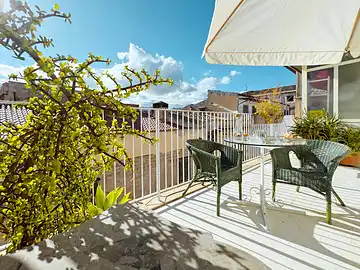
The terrace of the 'Casa Morricone' holiday flat in Palermo.
Casa Morricone

Holiday flats in the heart of Palermo

Our overview map shows all Solemar Sicilia holiday apartments in Palermo. To see them, simply click on "Holiday Lettings" on the left-hand side of the map.

Solemar Sicilia offers a wide range of holiday apartments. They range from simple, functional apartments ("I'm here to see Palermo, not to stay indoors") to a small penthouse like Casa Morricone shown in the picture ("you have to treat yourself once in a while").

To narrow down your search for a holiday apartment, you will find a simple filter here:

The terrace of the 'Terrazza del Merlo' flat in Palermo.
Terrazza del Merlo

Your own flat in Palermo

A nobleman's palace or a penthouse in the old town - of course, that is some­thing truly special, in a truly special city.

Fortunately, however, there is considerably more ac­com­mo­dation available for "ordinary" budgets, even in the old town.

And those who search patiently can even find something with a wonderful terrace, like the Terrazza del Merlo shown here. The apartment was bought and re­no­vated by German expats and is now a popular holiday apartment in Palermo's old town:

Sicily - Instagram - Britta Bohn

Sicily without mass tourism

Discover Sicily from a whole new perspective! Britta's Instagram page features a collection of photos showcasing beautiful spots away from mass tourism:

Sizilien - Facebook Groups Icon

Mail from Sicily

No, you don't need carrier pigeons to get news from Sicily. Today we have a Facebook groups. This source of information is completely free of charge and you can of course "switch it off" at any time:

Meet our Partners

Solemar Sicilia - Logo

Solemar SiciliaRents holiday lettings in Bagheria, Cefalù, Palermo and Santa Flavia.

Solemar Academy - Logo

Solemar AcademySicily's Best Language School in Cefalù.

Property in Sicily - Logo

Property in SicilyAssists homebuyers in Sicily.

Sicula Services - Logo

Sicula ServicesAssists homeowners in Sicily.

Sicula Bike - Logo

Sicula BikeRents bikes in Bagheria and Santa Flavia.

Sicily • All in one Place

Sicily • All in one Place

What does this photo montage show?

Top left: The 'La Cala' marina, with Palermo's old town in the background.

Top right: The 'Villa Bonanno' Palm Park.

Bottom left: La Dolce Vita in the pedestrianised area of 'Via Principe di Belmonte'.

Bottom right: The historic market 'Lo Capo'.